 Torah Feed
Why we read Ruth on Shavuot, and how to read the whole book before the holiday
Four chapters about loyalty, a harvest and the family of King David. What happens in the book of Ruth, why it is read on Shavuot, and a pace that finishes it in a week or two.
Updated May 18, 2026
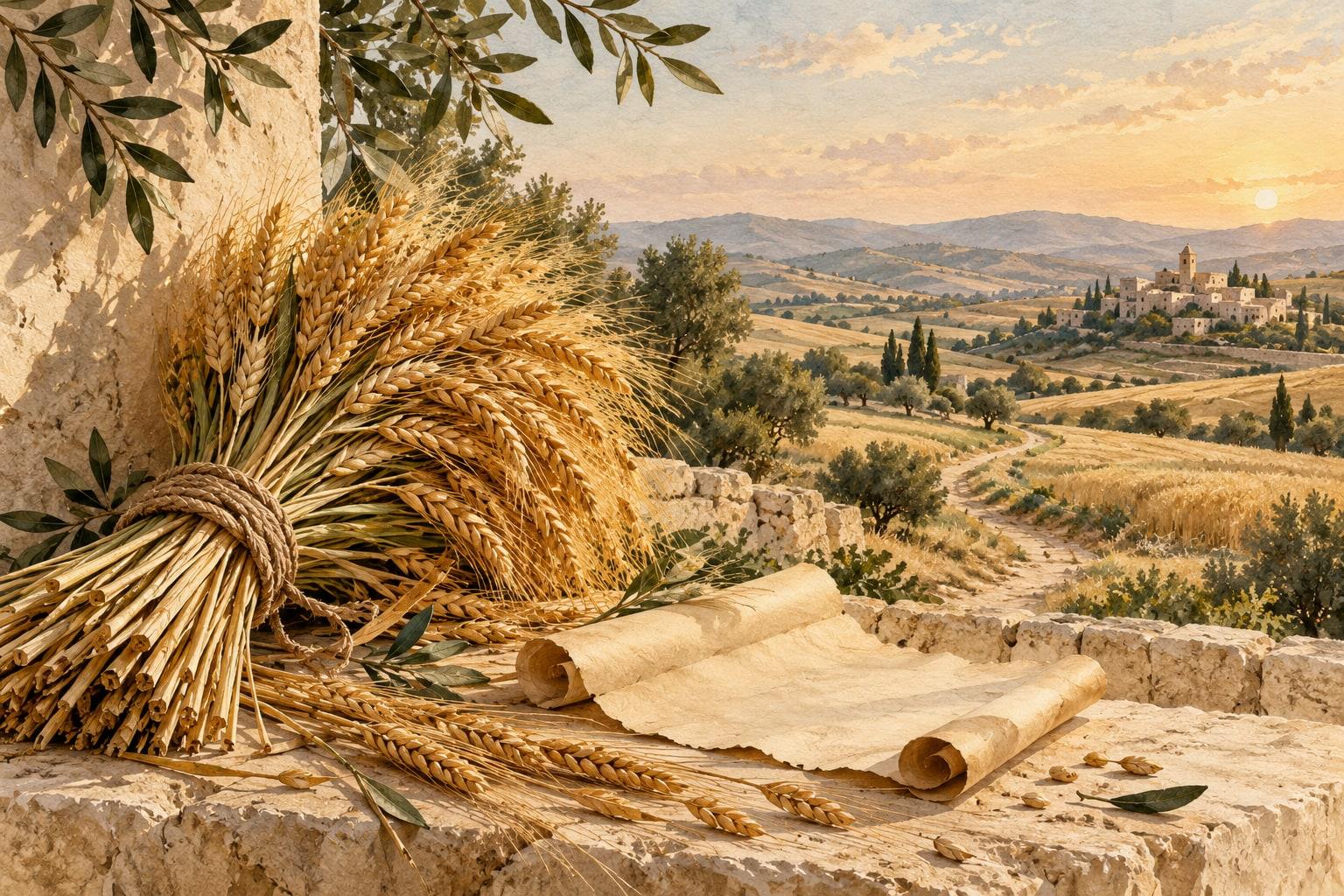
Ruth is one of the shortest books in the Tanakh and one of the easiest to love. It has no battles, no laws and no prophecy. It is a story about two widows, a field of barley, and a man who does more than he has to. On Shavuot, many communities read the whole thing aloud.
If you have never read it yourself, the weeks before Shavuot are the natural time to start. It is short enough to finish in a week of spare minutes, and then you hear it in shul as a story you already know.
The story in four chapters
Chapter 1 (22 verses). In a famine in the days of the judges, Elimelech leaves Bethlehem with his wife Naomi and their two sons for the fields of Moab. The sons marry Moabite women, Orpah and Ruth. Then Elimelech and both sons die. Naomi decides to go home and tells her daughters-in-law to return to their own families. Orpah kisses her goodbye. Ruth refuses to leave.
וַתֹּאמֶר רוּת אַל־תִּפְגְּעִי־בִי לְעָזְבֵךְ לָשׁוּב מֵאַחֲרָיִךְ כִּי אֶל־אֲשֶׁר תֵּלְכִי אֵלֵךְ וּבַאֲשֶׁר תָּלִינִי אָלִין עַמֵּךְ עַמִּי וֵאלֹהַיִךְ אֱלֹהָי׃
And Ruth said: ‘Entreat me not to leave thee, and to return from following after thee; for whither thou goest, I will go; and where thou lodgest, I will lodge; thy people shall be my people, and thy God my God;
Chapter 2 (23 verses). The two women arrive in Bethlehem at the start of the barley harvest with nothing. Ruth goes out to glean, gathering the stalks the reapers leave behind, which the Torah sets aside for the poor and the stranger. She happens on the field of Boaz, a relative of Elimelech, who has heard what she did for Naomi and goes out of his way to protect and feed her.
Chapter 3 (18 verses). At the end of the harvest, Naomi sends Ruth to the threshing floor at night to ask Boaz to act as the family’s redeemer, the relative who would marry her and keep Elimelech’s name and land in the family. Boaz agrees, but there is a closer relative with the first claim.
Chapter 4 (22 verses). At the town gate, before ten elders, the closer relative gives up his right. Boaz marries Ruth. Their son Obed is placed in Naomi’s arms, and the book ends with a list of generations: Obed was the father of Jesse, and Jesse the father of David.
Why it is read on Shavuot
The tradition gives more than one reason, and they fit together.
- The harvest. Shavuot is the festival of the wheat harvest, and the book runs from the beginning of the barley harvest to the end of the wheat harvest (Ruth 2:23). It is the one book of the Tanakh set in the season of the holiday.
- Accepting the Torah. Shavuot marks the giving of the Torah at Sinai. Ruth chooses the Torah and the Jewish people with nothing to gain and a great deal to lose, and her words to Naomi are often read as the model for that choice.
- King David. The book closes with David’s family tree. A tradition recorded in the Jerusalem Talmud holds that David died on Shavuot, and later sources add that he was born on it as well.
- Kindness. The midrash Ruth Rabbah (2:14) has Rabbi Zeira say that this scroll contains no laws of purity or impurity, nothing forbidden and nothing permitted. Why was it written? To teach how great the reward is for those who do kindness.
A pace for the weeks before Shavuot
Ruth is 85 verses. That gives you a lot of room.
| Verses a day | Finished in |
|---|---|
| 6 | 15 days |
| 12 | 8 days |
| 22 | 4 days |
At a chapter a day it is four days. At six verses a day, which is a couple of minutes, it is about two weeks. Any of them works, because the book is short enough that even the slow pace ends before the holiday does.
What to look for as you read
Names matter in Ruth. Naomi means “pleasant,” and when she comes home she tells the women of Bethlehem to call her Mara, “bitter,” instead (1:20). Watch how the book slowly gives her back her name.
Watch the word chesed, loving-kindness, too. Naomi uses it of Ruth and Orpah in the first chapter, and Boaz uses it of Ruth in the third. The book’s idea of kindness is concrete: leaving extra grain on purpose, walking someone home, going to the town gate to settle a family’s affairs. Nobody in Ruth works a miracle. Every turn in the story is someone choosing to do more than they owe.
And notice how little God appears directly. Characters bless each other in God’s name, but the story moves through ordinary choices, which is part of why it reads so close to life.
Reading it on your phone
You can read Ruth on this site in Hebrew and English, a chapter to a page. In Torah Feed it is one pasuk per screen, and it has its own challenge: the whole book of Ruth in fourteen days. The app keeps your place and counts the verses down, and when you finish, it marks the siyum. Start two weeks before Shavuot and the last verse, the one with David’s name in it, lands just before the holiday.
If Shavuot has you thinking about a bigger commitment, the arithmetic in what five minutes of Torah a day adds up to is a good next read.
Common questions
Why is the book of Ruth read on Shavuot?
Several reasons are given. The story takes place during the barley and wheat harvests, and Shavuot is the harvest festival. Ruth takes on the Torah and the Jewish people by choice, as Israel did at Sinai, which Shavuot celebrates. And the book ends with the family line of King David, who by tradition was born and died on Shavuot.
How long does it take to read the book of Ruth?
Ruth is four chapters and 85 verses. Read straight through in English it takes about fifteen to twenty minutes. Following the Hebrew as well, about 13 verses a day finishes it in a week.
Who wrote the book of Ruth?
The Talmud (Bava Batra 14b) says the prophet Samuel wrote it, along with the book of Judges, in whose time the story is set.
What does Ruth say to Naomi?
"Whither thou goest, I will go; and where thou lodgest, I will lodge; thy people shall be my people, and thy God my God" (Ruth 1:16, JPS 1917). She goes on to say that only death will part them.